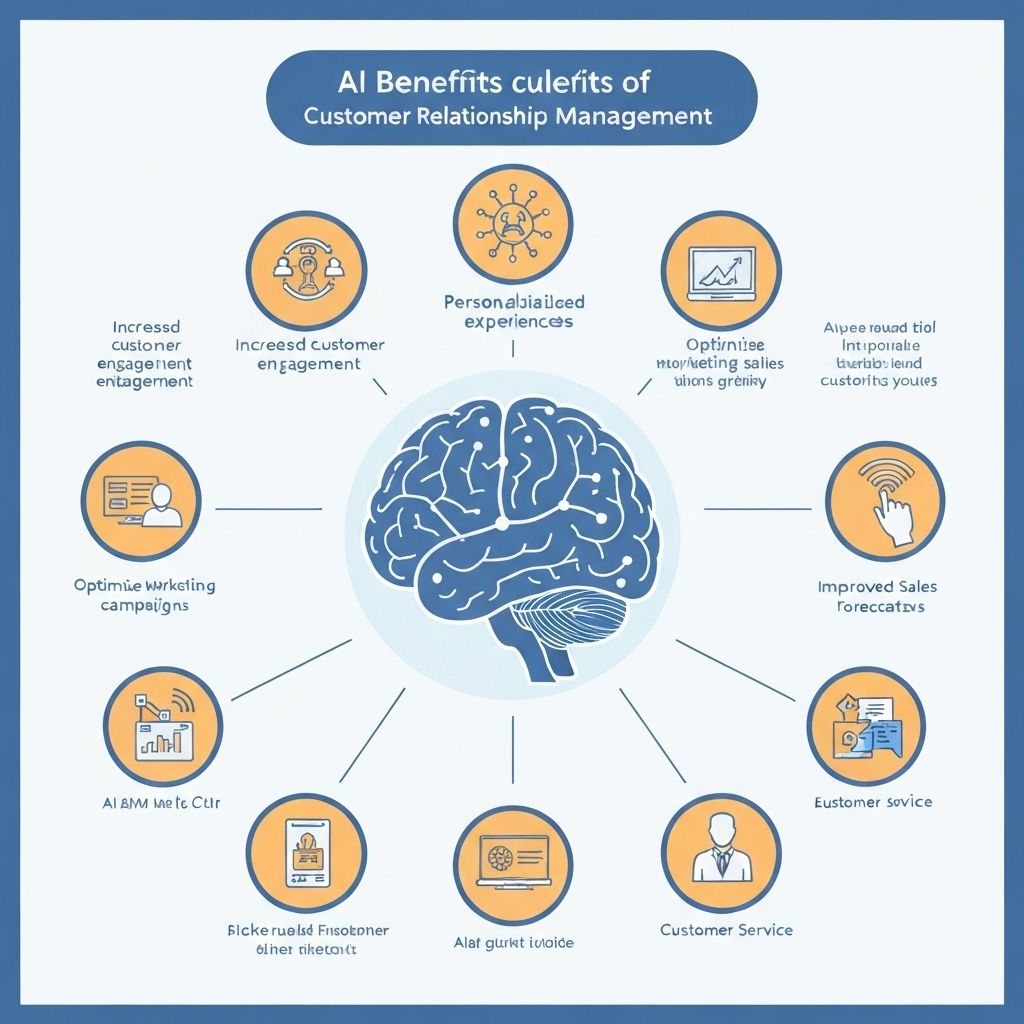
The Customer Relationship Management (CRM) system is the heartbeat of any growth-focused organization. Today, simply tracking contacts and pipelines isn't enough. By integrating **Artificial Intelligence (AI)**, CRM transforms from a static database into a dynamic, predictive revenue engine. This guide breaks down the definitive **Top 10 Benefits of AI-Powered CRM Systems**, offering concrete implementation tips to drive exponential growth.
AI augmentation is the difference between recording history and predicting the future. It allows sales, marketing, and service teams to operate with a level of insight and automation previously impossible, directly impacting bottom-line metrics like revenue, efficiency, and **customer retention**.
I. Benefits for Sales & Revenue Generation (The Top 5)
AI's immediate impact is felt in the sales organization, dramatically improving pipeline health and forecast accuracy.
1. 🎯 Predictive Lead Scoring (PLS)
AI analyzes historical conversion data, intent signals, and demographic factors to assign a dynamic score to every new lead. This ensures sales teams focus 90% of their time on the 10% of leads most likely to close. Implementation Tip: Integrate PLS with lead routing rules so hot leads skip manual assignment queues.
📈 2. Accurate Revenue Forecasting
AI processes variables (rep sentiment, engagement history, pipeline stage duration) far more accurately than human estimates. This provides finance teams with a clean, low-variance forecast, reducing QTR end surprises by up to 25%. Implementation Tip: Use historical model accuracy as a key metric for your AI system itself.
🧹 3. Automated Data Cleansing & Entry
AI agents automatically fill missing fields, standardize names and addresses, and flag duplicate records. This saves reps 5-10 hours per week on administrative work, drastically improving data quality for everyone else.
📞 4. Next-Best-Action Recommendations
Based on a contact's recent behavior (website visit, email open, service ticket), AI suggests the optimal next step for the rep (e.g., "Send Proposal B," "Schedule follow-up call," or "Send case study"). This keeps the sales process moving efficiently.
⬆️ 5. Upsell and Cross-sell Identification
AI models analyze customer product usage, support tickets, and contract data to flag accounts that are ready for a new product or an upgrade. This is often the lowest-cost source of new revenue. Implementation Tip: Trigger an internal Slack alert to the Account Manager 30 days before contract renewal with the AI's recommendation.
II. Benefits for Marketing & Service Teams (The Next 5)
AI extends far beyond just sales, fundamentally transforming how you market to and serve your existing customers, which directly impacts retention and lifetime value (LTV).
💧 6. Proactive Churn Prediction
This is one of the most valuable AI use cases. Models analyze usage decline, support ticket volume, and negative sentiment to score customers at risk of leaving. This allows service and success teams to intervene before the customer reaches out to cancel.
Retention is the new acquisition. AI makes it preventative, not reactive.
💬 7. Intelligent Chatbot Routing & Triage
AI-powered bots handle 70-80% of Tier 1 queries instantly. More importantly, they accurately categorize and route complex issues to the correct human agent immediately, minimizing wait times and improving the customer experience (CX).
📧 8. Hyper-Personalized Marketing Journeys
AI moves beyond basic segmentation (age, location) to behavioral segmentation. It determines the optimal content, channel (email vs. SMS), and time of day for every single customer, resulting in significantly higher **Click-Through Rates (CTR)**.
✍️ 9. Automated Content Generation (Drafting)
LLMs embedded in the CRM draft personalized email responses, summarize support tickets for handoffs, and create initial call scripts tailored to a customer's profile and recent pain points. This drastically increases agent productivity.
⚙️ 10. Process Automation & Workflow Triggers
AI connects disparate systems. When an invoice is overdue (Billing system), the CRM automatically creates a high-priority task for the account manager (Sales) and changes the customer's status (Service). This level of integration prevents tasks from falling through the cracks.
🛠️ III. Implementation Blueprint: Getting Started with AI CRM
Adopting an AI-powered CRM is a phased approach, not an overnight switch. These critical steps ensure your investment pays off quickly:
Phase 1: Data Readiness and Infrastructure
- 1. 🗄️ Data Consolidation & Quality Audit: Ensure all customer data (CRM, ERP, website, support) is unified and free of duplicates. AI models are only as good as the data they consume.
- 2. 🔗 API Integration Strategy: Plan out the data contracts between your AI services (like predictive models) and the core CRM platform. Latency matters for real-time recommendations.
- 3. 🧠 Select a Pilot Use Case: Don't start with all 10 benefits. Start with **Predictive Lead Scoring** or **Churn Prediction**, as they offer the fastest, clearest ROI.
Phase 2: Training, Validation, and Deployment
- **Model Training:** Use at least 2 years of historical data to train the AI on successful and unsuccessful outcomes (e.g., closed-won vs. closed-lost deals).
- **Shadow Testing:** Deploy the AI model in "shadow mode"—running it against live traffic but **not** displaying the results to users—to validate accuracy against a control group.
- **User Training:** Train sales and service teams not just on *how* to use the new features, but *why* the AI provides a certain score or recommendation. Trust is key to adoption.
🚧 IV. Common Pitfalls and Mitigation Strategies
The road to an AI-powered CRM is not without bumps. Being aware of these pitfalls allows you to mitigate them proactively:
🚫 Pitfall: Data Silos and Inconsistency
Description: Customer data remains locked in separate systems (Marketing Automation, Billing, Support Tickets), preventing the AI from having a complete view.
Mitigation: Enforce a single source of truth (the CRM) and implement a **Customer Data Platform (CDP)** layer to ingest and unify behavioral data before AI consumption.
📉 Pitfall: Over-Automation and User Fatigue
Description: Automating too many tasks or flooding sales reps with irrelevant AI recommendations leads to them ignoring the system entirely.
Mitigation: Implement a **Human-in-the-Loop (HITL)** strategy. AI should surface insights, not dictate actions. Allow users to "thumbs up/down" recommendations to tune the model.
⚠️ Pitfall: Model Drift (Post-Deployment)
Description: The predictive model's accuracy degrades over time because the market, product, or customer behavior changes (i.e., concept drift).
Mitigation: Establish robust MLOps practices, including **Continuous Training (CT)** pipelines that automatically retrain the model when a performance threshold is breached (see our MLOps Guide).
🔎 Pitfall: Lack of Transparency (Black Box)
Description: Users do not trust the AI's output because they cannot understand *why* a customer was scored as high-risk or a lead was scored as low-value.
Mitigation: Use Explainable AI (XAI) techniques (like SHAP values) to show the top 3 factors driving the AI's score directly within the CRM interface.
🚀 V. The Long-Term Impact on Organizational Growth
The transformation to an AI-powered CRM is not just about incremental gains; it's about shifting the sales and marketing culture from reactive to **hyper-proactive**. When AI takes over the monotonous tasks, your human talent is freed to focus on high-touch, relationship-building activities that truly drive enterprise value.
KPIs for AI-Powered Growth
Success should be measured by these metrics:
- ✅ Pipeline Velocity (time from MQL to SQL reduced by X%)
- ✅ Customer Lifetime Value (CLV) increased by Y% due to reduced churn
- ✅ Sales Rep Time Allocation (X hours/week shifted from data entry to selling)
In 2025, the CRM is the **central nervous system** of customer operations. Integrating AI is the upgrade that activates its full cognitive potential, turning raw data into strategic foresight and unparalleled customer engagement.
Ready to Predict Your Next Customer Win?
Hanva Technologies builds custom, AI-integrated CRM and sales platforms designed for maximum adoption and measurable ROI.
Start Your AI-CRM Transformation